
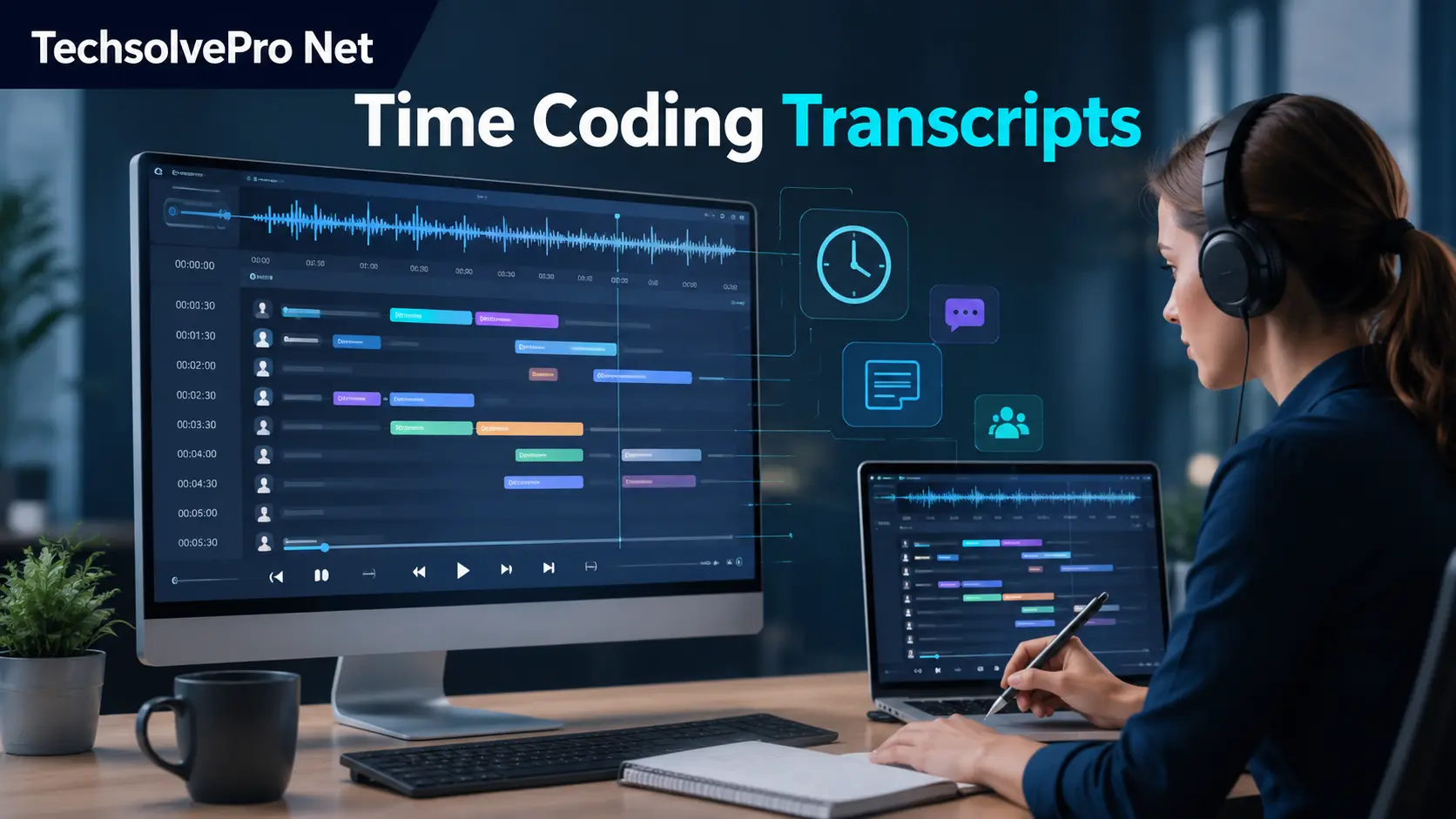
Picture this you’re three hours into a rough cut and you need one line an interviewee said somewhere in a ninety minute sit-down. Without a map, you’re scrubbing blindly. With time coding transcripts, you type the phrase, click the result and you’re standing on the exact frame in seconds.
AI transcription tools that single shift from scrubbing to searching for is why so many editing teams have rebuilt their workflows around this practice. It’s not a gimmick. It’s a practical fix for one of the most time consuming parts of post production and once you see it work on a real project, it’s hard to go back to the old way.
What Time Coding Transcripts Actually Do
At it has core a time coded transcript pairs every line of spoken dialogue with a precise point in the video or audio file. Instead of a plain wall of text, you get a document where each sentence carries it has own address like a timestamp or frame accurate code that tells you exactly where it lives in the footage.
This matters because raw footage has no built in index. A two hour interview has just a long and undifferentiated stretch of audio and video until someone attaches structure to it. Software applications time coding transcripts supply that structure turning footage into something you can search like skim and jump through like a document instead of a tape.
Editors, producers and researchers all lean on this because it removes guesswork. You have no longer rely on memory (“I think she said that around the 40-minute mark”). You’re working from a precise reference that holds up across an entire production.
Timecode vs. Timestamp
People often use these terms losing functionality but they solve slightly different problems. Knowing the difference will save you real headache on set and in the edit bay.
A true timecode the SMPTE style formatted as hours:minutes:seconds:frames like locks to the camera and internal clock of audio. It’s frame accurate which makes it essential when you need to sync multiple cameras and conform an edit or hand off a caption file that must match the picture exactly.
A timestamp on the other hand is usually a looser marker in every 15 seconds, every 30 seconds and at each change of speaker. It has built for quick navigation and skimming rather than frame level precision. Research teams, journalists pulling quotes and social media editors hunting for a soundbite usually only need this level of detail.
| Feature | Timecode | Timestamp |
| Precision | Frame accurate | Second or interval based |
| Best for | Multicam sync, captioning, broadcast delivery | Quote-finding, skimming, quick review |
| Tied to master clock | Yes | Not always |
| Common use case | NLE editing, compliance logs | Research, social clips, notes |
Many production teams keep both like a frame accurate master file for the edit suite and a lighter, timestamped copy for producers and writers who just need to skim for content.
Why Editors Build Their Workflow Around This
The appeal isn’t abstract as it shows up in hours saved on every project. When you can read a transcript and click straight to a line then you skip the single most tedious task in post production like manually hunting through footage.
Paper edits become realistic again. A producer can mark selects directly in the text, hand that list to an assistant editor and have a rough string out assembled before the director even sits down. That’s a workflow that simply doesn’t exist when everyone has to scrub footage by eye.
It also changes how feedback works. A note that says “tighten the pacing around 12:40” is vague. A note tied to a specific timecode, referencing the exact line of dialogue and tells the editor precisely what to fix and why is no back and forth required.
Technique Pays Off Beyond the Edit Bay

Time coding transcripts aren’t just an editing convenience. They ripple out into several other part of a production pipeline where speed and accuracy both matter.
Captioning and subtitling teams use the same timed text as the backbone of their caption files. So dialogue lines up with speech without a second round of manual timing work. Legal and compliance teams rely on timed transcripts to build defensible records of exactly what aired and when. Multilingual productions use the same source file as the anchor for translated subtitle tracks and keeping timing consistent across every language version.
Even outside formal production, researchers analyzing interviews, corporate teams archiving training sessions and marketing teams repurposing long form video into short clips all benefit from the same underlying idea like attach time to text and suddenly hours of raw content become searchable.
Practical Ways Teams Put This to Work
- Documentary editors scan interview transcript to spot recurring theme across dozens of sit downs without rewatching a single clip.
- News teams pull exact quote for lower thirds and voiceover scripts under tight deadlines.
- Corporate trainers tie town hall recordings to specific policy moments so employees can jump straight to what matters.
- Marketing teams lift short and punchy lines from long interviews to build promotional cutdowns.
- Legal reviewers verify claims made on camera by jumping to the exact moment a statement was recorded.
Building an Accurate Timed Transcript From Scratch
Getting this right starts before the camera even rolls. Clean audio a locked frame rate and a consistent recording plan all make the difference between a transcript that has genuinely useful and one that introduces more problems than it solves.
Start by deciding on your frame rate and code type before the first take and keep it consistent across every camera and audio recorder on set. Jam sync your devices at the start of the day and again after any battery swap or long break, since drift creeps in quietly and shows up as a real headache later.
Once the footage exists choose your timing detail based on the job. Short social clips benefit from word level timing. Long form interviews are usually more readable with sentence or paragraph level timing. Multi speaker panels need clear speaker labels layered on top of whatever interval you choose.
If you’re starting from a plain transcript without any timing at all, forced alignment tools can retroactively match text to audio and generate a timed file matching your project’s frame rate. Always run a human pass afterward. Embedded software automated alignment gets close but names, technical jargon and unusual phrasing still need a trained eye.
Formats Work With Your Editing Software
Latest technology time coded transcript has only as useful as the files it can export into. Most modern editing pipelines expect a handful of standard formats and knowing which one fits which task saves a lot of back and forth.
SRT files remain the simplest and most widely supported option for basic captions across nearly every platform. WebVTT adds styling and positioning which matters for web video players that need more visual control. TTML and IMSC are the formats broadcasters typically require since they carry richer metadata for compliance purposes. JSON meanwhile is less about human reading and more about automation. It stores word level timing and speaker data that other tools can process programmatically.
Editing software like Premiere Pro, Avid Media Composer and DaVinci Resolve can all ingest timed transcripts directly. Letting editors search text and pull matching clips straight into a sequence not than restoring everything by hand.
Accuracy Standards Worth Holding Yourself To
Not every transcript needs the same level of polish but setting a clear bar keeps quality consistent across a team. For internal editing purposes and aiming for roughly 95 percent accuracy has a reasonable working standard. For anything published publicly like captions, official transcripts, compliance records and pushing toward 98 percent or higher protects both viewers and your organization’s credibility.
A short human review pass catches what automated tools typically miss like proper names, industry jargon, numbers and overlapping speech. It has a small investment of time that prevents much larger headaches during caption QC or legal review later.
How to Use Time Coding Transcripts for Faster Video Production
Time coding transcripts have revolutionized the way video editors work in 2026. Instead of scrubbing through hours of footage manually, editors can now search specific words or phrases and jump directly to that moment in the timeline.
Best Tools for Time Coding Transcripts in 2026:
Several powerful tools make creating time coding transcripts faster and more accurate than ever before. Adobe Premiere Pro offers built-in transcript generation with automatic time codes. Descript allows editors to edit video directly from the transcript text. Otter.ai and Rev.com provide accurate automated transcription with precise time stamps for any video format.
How Video Editors Use Timed Transcripts:
Professional editors use time coding transcripts to identify the best takes quickly without rewatching entire recordings. They search for specific dialogue, remove filler words in bulk, and generate accurate captions automatically. This workflow can reduce post-production time by up to 60 percent for long-form content creators.
Common Pitfalls and How to Avoid Them

Drift has the most frequent problem teams run into usually caused by mismatched frame rates between cameras, audio recorders and proxy files. Locking your frame rate at the start of a shoot and rejamming sync points throughout the day prevents most of it before it ever becomes an issue.
Another common mistake has letting automated tools split sentences awkwardly at scene cuts, which breaks up captions in a way that hurts readability. Adjusting segmentation rules so cues respect natural sentence boundaries, rather than picture cuts, keeps captions readable and professional.
Finally, treat sensitive footage transcripts the way you can treat any confidential document. Redact personal information where it hasn’t need to appear, restrict access to sensitive interviews and set clear retention windows. So old files don’t depart promptly longer than necessary.
Final Thoughts
Time coding transcripts turn hours of raw footage into something searchable, editable and shareable across an entire team. Whether you have cutting a documentary, building captions or archiving a training session. The underlying principle stays the samelike attach time to text and the whole production process moves faster with fewer errors.
FAQs
What is time coding in transcription?
It has adding precise time markers (e.g., 00:02:14) to a transcript so each line matches its exact moment in the audio or video. It has used for editing, captioning and quick navigation.
How do I code an interview transcript?
Transcribe the audio then insert timestamps at set intervals or speaker changes. Label who’s speaking, proofread for accuracy and export as SRT/VTT or a timestamped text doc.
What have the different types of transcription?
Main type like verbatim (every word, including fillers), clean verbatim (fillers removed), edited/intelligent (polished for reading), phonetic (sound-based, used in linguistics) and time coded (any of these with timestamps added).
How long does it take to transcribe 1 hour?
Manually like about 4–6 hours. AI tools 5–15 minutes but need review. Professional services usually 24–48 hours turnaround.