
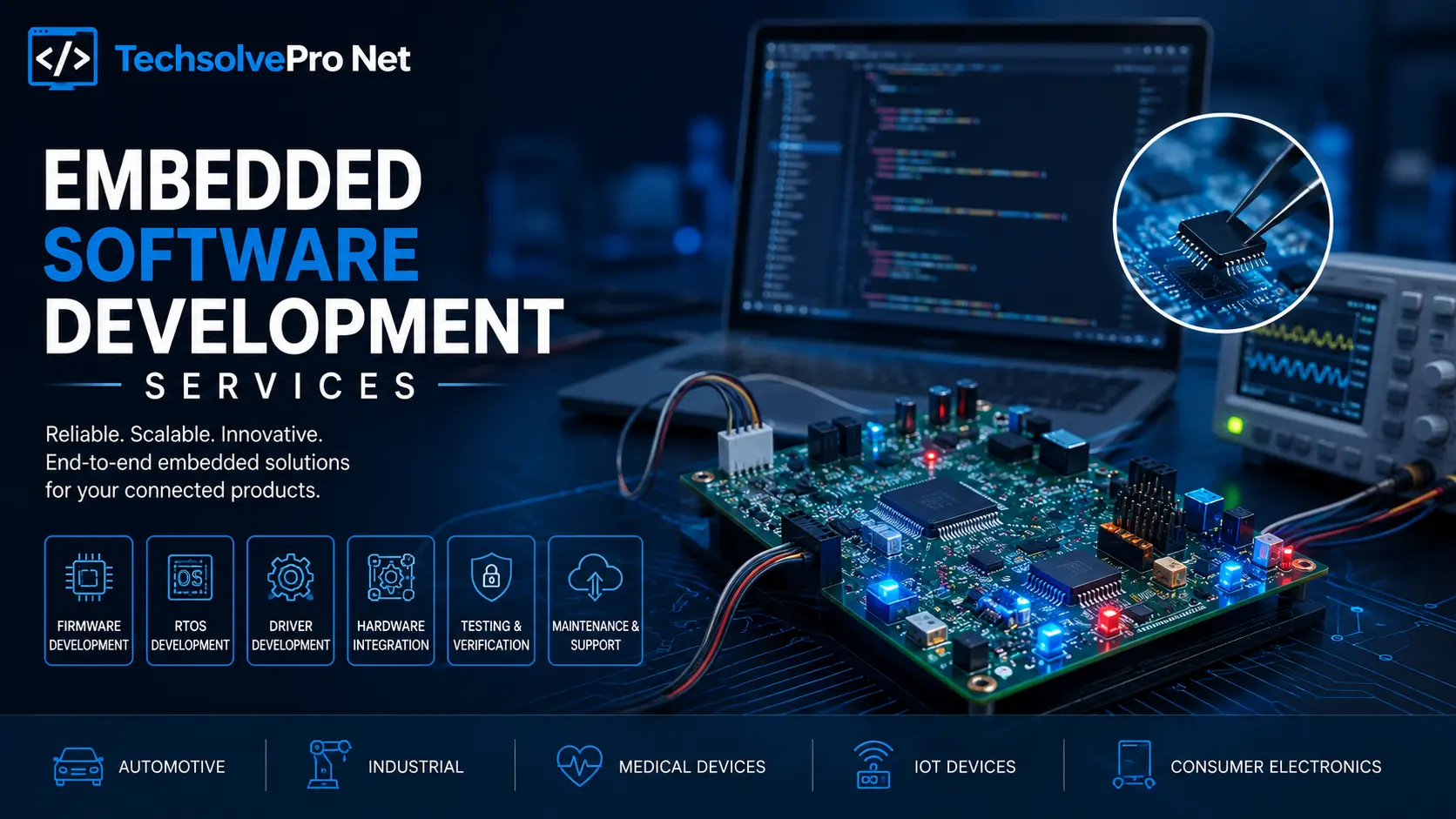
Every device around you from a hospital patient monitor to a factory robot to your car’s information system runs on embedded software. Without it the hardware is just metal and silicon. With it the device becomes intelligent, responsive and useful?
Demand for embedded software development services has surged across US industries as companies race to build smarter and more connected products. But not every team understands what these services actually involve and how to choose the right partner. This guide covers everything you need to make that decision confidently.
What Embedded Software Development Services Include
Most companies underestimate the scope. Embedded software development consulting services isn’t just firmware writing, it’s an entire engineering discipline that bridges hardware and software into a single reliable product.
A complete engagement covers electrical engineering firmware architecture, embedded Linux and edge AI are connectivity protocols, cybersecurity and user interface development. Each layer fully depends on the others. A firmware bug can trace back to an undocumented hardware behavior. A security vulnerability can stem from a misconfigured bootloader. The best teams own all of it.
- Electrical Engineering: PCB layout, schematic design, component selection, BOM optimization and manufacturing readiness
- Firmware Development: Bare metal and RTOS based development, driver writing, secure boot and performance tuning
- Embedded Linux: Custom BSP development, kernel configuration, Linux driver writing and user space application development
- Edge AI and ML: On device inference, model quantization, hardware-specific optimization and edge MLOps
- Connectivity and IoT: Wired protocols(CAN, Modbus and Ethernet) wireless (Wi-Fi, Bluetooth, LTE, LoRa and Zigbee)
- Embedded Cybersecurity: Encrypted storage, signed firmware, PKI infrastructure, OTA update and threat assessments
- GUI Development: Touchscreen and display interfaces built with Qt, LVGL or TouchGFX
Why Hardware-Software Integration Is the Core Challenge?
The most expensive mistakes in embedded development don’t happen during coding. They happen at the boundary between hardware and software teams.Embedded software development companies
When an electrical engineer completes a board design and hands it to a firmware developer without deep collaboration, integration problems pile up fast. Pin assignments get misinterpreted. Power sequencing isn’t accounted for in initialization code. Timing constraints that were obvious to the hardware designer never made it into the firmware spec.
These bugs surface late often during pre-production validation or field testing — when fixing them is genuinely expensive. Teams that co-own hardware and software from day one catch these issues in architecture review, not in the factory.
Industries That Demand the Most From Embedded Teams
Not every embedded project carries the same complexity or regulatory heavy load. Some industries require deep compliance knowledge alongside technical skill.
| Industry | Regulatory Standards | Common Devices |
| Healthcare | FDA, HIPAA, IEC 62304, ISO 13485 | Wearables, patient monitors, diagnostic imaging |
| Automotive | ISO 26262, ASPICE, ISO/SAE 21434 | ECUs, BMS, infotainment, ADAS systems |
| Energy | IEC 61850, IEC 62443, ISO 15118, OCPP | EV chargers, battery management, smart inverters |
| Industrial IoT | IEC 62443, IEC 61508, ISO 13849 | PLCs, IoT gateways, predictive maintenance systems |
| Transportation | ISO 26262, IEC 61508, OCPP | Fleet telematics, asset trackers, warehouse systems |
| Consumer Electronics | FCC Part 15, CE, RED | Smart home devices, wearables, e-mobility |
In regulated markets documentation has a deliverable not an afterthought. Traceability matrices, software development plans and tech files must be built alongside the product from the start. A partner who treats compliance as a final stage checklist will cost you months.
How to Evaluate Embedded Software Development Services Providers

Choosing an embedded development partner requires going beyond portfolio pages and sales decks. These questions expose what a team actually knows.
Do they have an in-house lab?
A real testing lab helps fix hardware issues faster than software simulation alone.
Which RTOS platforms are they worked with?
Experience gain with FreeRTOS, Zephyr, VxWorks, ThreadX or QNX shows they can chooses the best platform for your project.
Are they taken a product from prototype to production?
Building a prototype is easy. Mass production needs experience with manufacturing, testing and cost optimization.
How do they handle OTA updates?
Ask if their updates have secure, support rollback and can recover if something goes wrong.
What is their security approach?
Look for secure boot, firmware signing, encrypted storage and strong device protection from the start.
What does their security architecture look like?
Ask how they keep their devices secure. Look for features like secure boot, encrypted data, firmware signing and safe software updates. For IoT devices security should built in from the beginning not added later.
The True Cost of Embedded Development Mistakes
Companies that optimize for the lowest hourly rate on embedded development often pay far more in the end. Here has what the real numbers look like.
A PCB structured after tooling has cut typically runs between $50000 and $300000 depending on board complexity and layer count. A firmware security damaged that triggers a field recall can reach seven figures when you embrace logistics, replacement hardware and regulatory response. A failed regulatory submission adds months to your timeline and tens of thousands in engineering rework.
The smarter financial calculation looks at:
- How many revision cycles does architecture-first design eliminate?
- What has the cost of delayed market entry versus accelerated prototyping?
- How much does proper documentation support reduce regulatory submission risk?
- What has the long term cost of maintaining firmware that has been written without scalability in mind?
Edge AI Is Redefining What Embedded Systems Can Do
On device machine learning has crossed from experimental to production-ready. US manufacturers, healthcare companies and energy firms are now deploying inference models directly on microcontrollers and application processors moving intelligence to the edge rather than sending data to the cloud.
Real world applications already in production include vibration analysis for predictive maintenance on industrial motors, gesture and voice recognition on wearables, anomaly detection in battery management systems and computer vision quality control on manufacturing lines.
The engineering challenge is model optimization. A model that performs well in a training environment needs to be quantized pruned and profiled against the specific memory footprint and compute budget of your target hardware. This required embedded engineers who understand both machine learning workflows and microcontroller constraints like a combination that remains rare.
Teams deploying edge AI also need an MLOps strategy for embedded systems: how models have updated, versioned, validated in the field and rolled back if a new version underperforms.
What Strong Project Governance Looks Like on Embedded Programs
Embedded projects span more engineering disciplines than almost any other software engagement. Without clear governance, workstreams drift, elements timelines slip and regulatory commitments become hard to defend.
Strong embedded project management means defined SDLC stages with formal entry and exit criteria, requirements tracked with full traceability from specification through test, and design reviews conducted at architecture milestones not just at the end. For regulated industries, this structure is what makes a submission auditable.
Look for project managers who have worked in your specific regulatory environment. A PM experienced with FDA submissions understands what a design history file needs to contain. A PM experienced with automotive ASPICE understands how to structure software process documentation. Generic project management experience doesn’t transfer cleanly to embedded programs in regulated markets.
Legacy System Modernization: The Overlooked Opportunity

Many US companies are running embedded systems built on decade-old architectures. Processors without security support proprietary RTOS versions no longer receiving patches, and communication protocols that predate modern encryption standards create both operational and compliance risk.
Modernizing a legacy embedded system hasn’t just a technical upgrade. It’s often a business continuity decision. When a microcontroller goes end of life and parts become unavailable then companies face forced redesigns under time pressure far more expensive than planned migrations.
A structured suitable for today’s standards engagement starts with a full audit of the existing hardware software stack to recognize which components carry the most risk and defines a phased migration path that maintains operational continuity throughout the transition.
Why US Businesses Choose Custom Embedded Software Development Services
The demand for embedded software development services has grown significantly across US industries in 2026. Businesses are no longer satisfied with generic solutions — they need custom firmware, IoT integration, and edge AI capabilities that match their exact operational requirements.
Key Industries Using Embedded Software in the US:
Manufacturing companies rely on embedded systems for real-time process control and automation. Healthcare organizations use embedded software for medical devices and patient monitoring systems. Automotive companies depend on embedded development for advanced driver assistance systems. Defense and aerospace sectors require highly reliable embedded solutions for mission-critical applications.
What to Look for in an Embedded Software Development Partner:
Choose a development partner with proven experience in firmware development and hardware integration. Ensure they have expertise in IoT protocols and edge AI implementation. Look for companies with strong quality assurance processes and US-based support teams for faster communication and project management.
Final Thoughts
The gap between a good embedded concept and a reliable compliant manufacturable product is where most hardware programs struggle. Bridging that gap requires more than tech skill it requires process discipline cross domain integration experience and genuine accountability for outcomes. Selecting the right embedded software development services partner has one of the highest leverage decisions you’ll make in a hardware program. Evaluate carefully ask the hard questions and energy proven delivery over impressive proposals.
FAQs
What’s the difference between firmware and embedded software?
Firmware is the basic software thats controls the hardware. Embedded software includes firmware plus other software such as the operating system, communication features and application functions.
How much do embedded software development services cost in the US?
The cost depends on the size and problems with multiple layers of the project. Small firmware projects may cost around $30,000 to $50,000 while large projects like medical or automotive devices can cost $300,000 to $1 million.
What is an RTOS and why is it important?
An RTOS helps devices perform tasks on time without delays. It is important for devices that need fast and reliable responses such as medical equipment, industrial machines and automotive systems.
How do embedded development teams handle cybersecurity?
Good teams build security into the product from the beginning. They use secure boot for encrypted data, signed software updates and regular security testing to keep devices safe from cyber threats.