
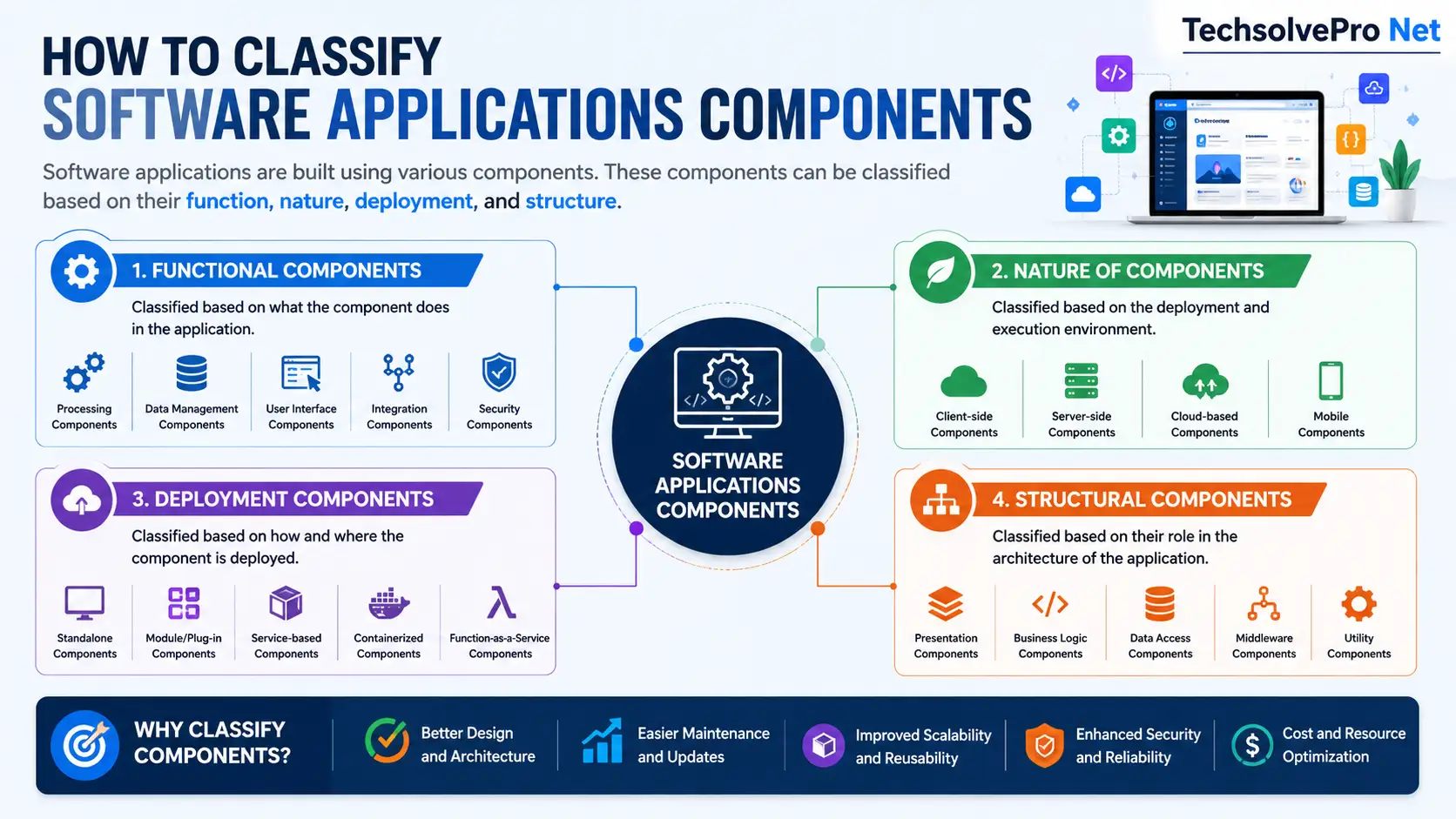
Every software project is made up of different parts that work together but many teams find it difficult for logical structure them in a way that truly supports development. Learning how to classify software applications components is one of the most useful skills a developer, architect or project manager. This because it changes a complex codebase into a system that is easier to maintain and grow.
This guide explains the process in simple language using real world examples and a step by step methods instead of complex theory. By the end you will clearly understand where each tech part of your application belongs and why its place has important.
Why Component Classification Matters
A software application rarely fails because of one bad line of code. It usually fails because nobody understood how the pieces connected to each other. How to classify software applications components solves this by giving every module a clear role and a clear place in the bigger picture.
When components have grouped properly then debugging becomes faster because problems can be traced to a specific layers instead of the entire codebase. New team members also onboard faster since the structure explains itself.
Teams that skip this step often end up with complicated dependencies, duplicated logics and features that quietly break other features. A little structure early on saves weeks of cleanup later.
Core Categories Of Software Components
Most applications share a common set of building blocks even if the technology stack conflicts. Understanding these categories has the foundation for how to classify software applications components in any project like large or small.
Functional Components
These handle specific business tasks such as processing a payment, generating a report or verifying a login. They contain the actual logic that make the application useful to its users.
Structural Components
These form the backbone of the system as well as database connectors, API gateways and communication layers. They do not perform business logic themselves but allow other components to talk to one another.
Interface Components
These manage how users or other systems interact with the application. Examples as well as a graphical dashboard, a REST API or a command line tool.
Reusable And Non Reusable Components
Some pieces like a logging library or an authentication module have built to be dropped into multiple projects. Others have tightly coupled to a single application and cannot be reused somewhere else without significant rework.
What Are The Components Of A Software Application
- Beyond high level categories most modern applications follow a layered structure that make these classification more predictable. Recognizing these layers helps teams isolate problems and plan updates without breaking unrelated parts of the system.
- Presentation layer components that manage the visual interface and user interactions
- Business logic layer components that hold rules, calculations, and workflow decisions
- Data access layer components that connect to databases and storage systems
- Integration components that link the application to third party services or external APIs
- Utility components that provide shared functions such as logging, validation, and error handling
How To Categorize Application Software By Purpose
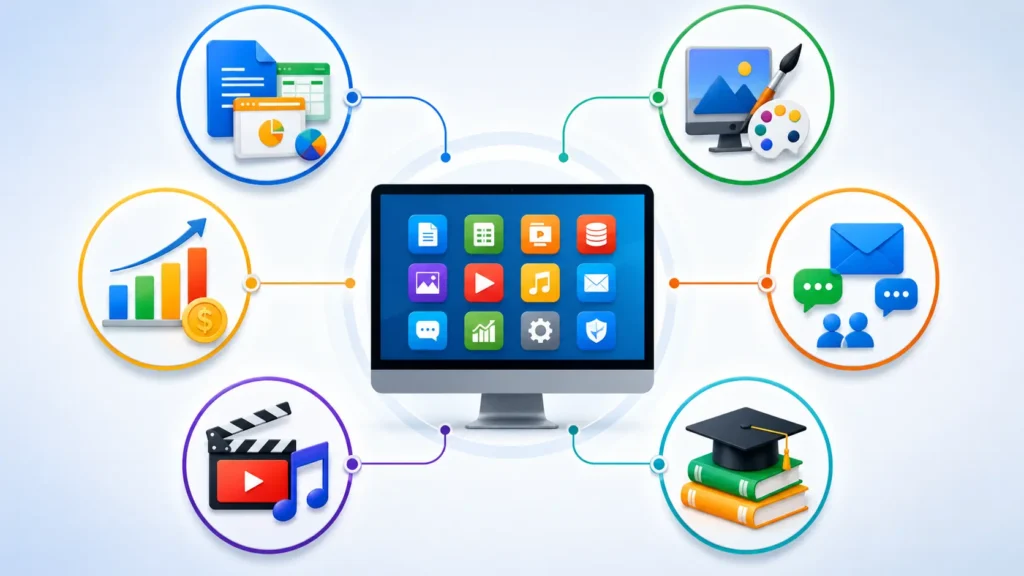
Categorizing an entire application not just its internal pieces. It is equally important for planning and licensing decisions. Applications are typically grouped by function, deployment method, architecture and ownership.
| Category Type | Common Examples |
| By Function | System software, productivity tools, enterprise platforms |
| By Deployment | Desktop apps, web apps, mobile apps |
| By Architecture | Monolithic systems, microservices, client server models |
| By Ownership | Proprietary software, open source software, freeware |
A Practical Approach To Classifying Components
Turning theory into practice does not require complicated tools. A short repeatable process has usually enough to bring order to even a large codebase.
Start by listing every module, library, and interface currently in use. Next, identify what each piece actually does and how critical it is to daily operations. From there, group items by dependency, separating core functionality from supporting utilities.
Once grouped label which components can safely be reused somewhere else and which have tied permanently to this one project. Finally write it all down. A shared document that outlines each classification saves huge time when new developers join or when the system needs an audit.
Licensing And Ownership Considerations
Classification has not only a technical exercise. It also protects a business legally and financially. Proprietary components cannot be modified without permission while open source pieces come with their own rules under licenses like MIT or GPL.
Third party licensed tools often carry usage limit or subscription requirement that need to track closely. Missing this step can create compliance headache during audits or acquisitions. So, it deserve the same attention as the technical side of classification.
Tools That Make Classification Easier
Manual spreadsheets work well for small projects but as the codebase grows, most teams start using dedicated tools to keep component classification clear and accurate.
Depend on these management tools such as Maven, Gradle, or npm show how different modules depend on one another. Visual tools like UML diagrams or the C4 model present that information in a sense the whole team can quickly understand. Code analysis tools such as SonarQube identify structural problems before they turn into expensive bugs that while a shared documentation platform helps everyone stay on the same page about where each component belongs.
Where Classification Pays Off Most
Some industries and project types benefit more than others from a disciplined classification approach, simply because their systems carry more complexity or risk.
Enterprise platforms rely on clean separation to support large ERP or CRM systems without collapsing under their own weight. Mobile applications need classification to manage limited device resources efficiently. Web applications built on microservices depend on it for reliable API management, and embedded systems require a strict divide between hardware level code and business logic to function safely.
Final Thoughts
Mastering how to classify software applications components gives the teams a lasting advantage not just a cleaner codebase for today. It shortens debugging time, simplifies onboarding, protects against licensing risk and makes future scaling now less painful. Whether the project has a small mobile app or a sprawling enterprise platform. A clear classification system is the difference between software that grows smoothly and software that eventually becomes impossible to maintain.
FAQs
Why does classifying software components matter for a small team?
Even small teams benefit because clear classification prevents duplicated code, speeds up debugging. That’s makes it easier to onboard new developers without guessing how the system fits together.
Can one component belong to more than one category?
Yes. A logging module for example can be both a utility component and a reusable one that since it supports the system while also being portable across other projects.
How often should classification be reviewed?
It is worth revisiting classification whenever major features are added or the architecture changes significantly, since new components can shift how existing ones are grouped.
Does licensing really affect how components are classified?
Yes. Open source, proprietary, and third party licensed components each carry different usage rules, so licensing status should always factor into how a component is categorized and documented.