
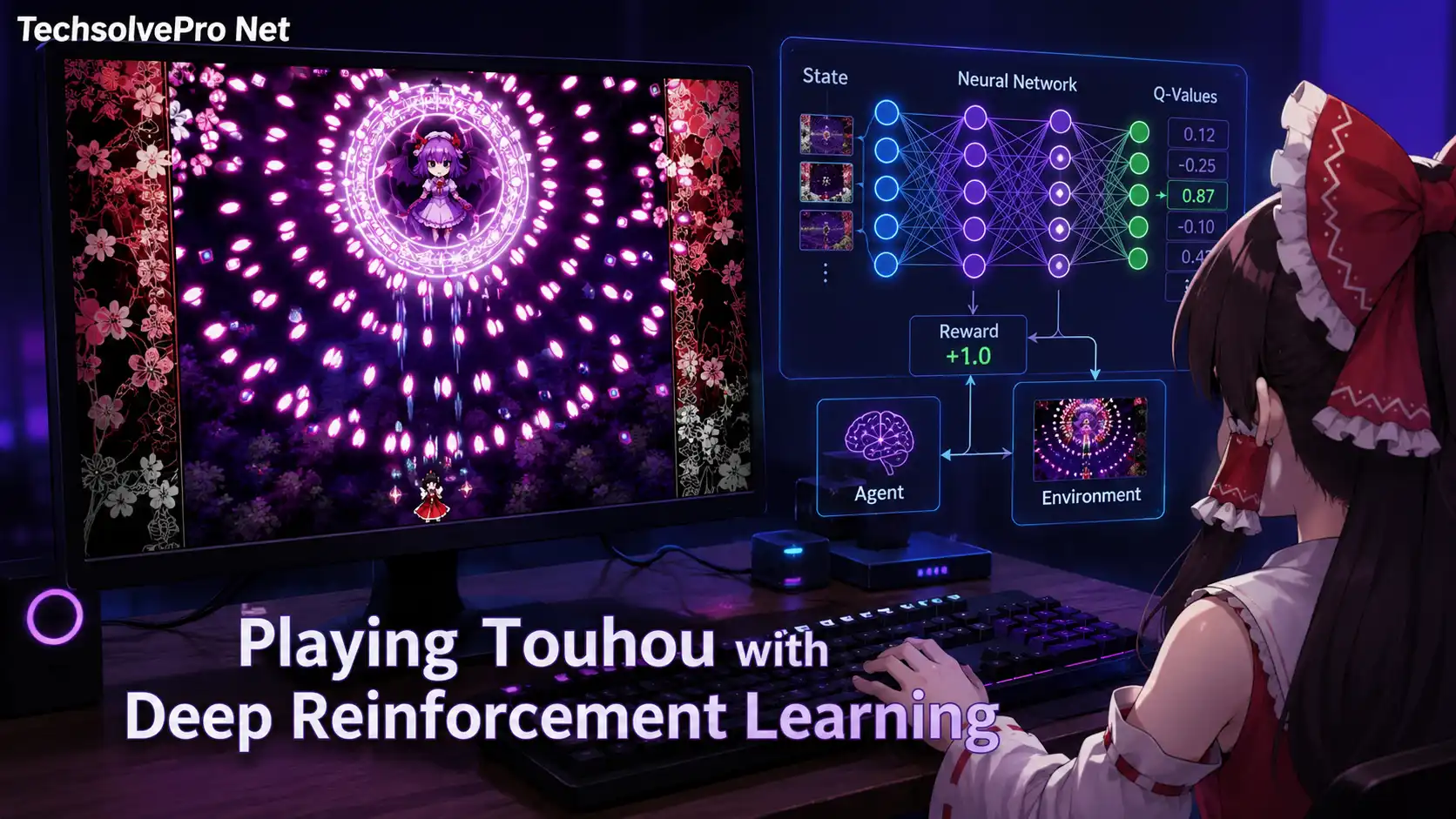
Bullet hell games push human reflexes to their absolute limit and few series test that limit harder than Touhou. Teaching a machine to survive that chaos has exactly why playing Touhou with deep reinforcement learning has become such a fascinating challenge for hobbyist coders and academic researchers alike.
Unlike chess or Go where an AI can calculate several moves ahead. Touhou demands split second reactions to hundreds of moving bullets on screen at once. That combination of speed, chaos and precision makes it one of the toughest real time environments for reinforcement learning to conquer.
Why Touhou Is a Brutal Testing Ground for AI
Touhou has a vertically scrolling shoot’em up where the player dodges dense bullet patterns while returning fire. Four difficulty tiers exist and Lunatic mode is where even skilled human players struggle.
What makes it so hard for AI isn’t just the volume of bullets. It’s the timing. A delay of even a few frames can mean instant death. So any agent has to process visual or positional information and act almost instantly frame after frame.
What Is Deep Reinforcement Learning in Plain Terms?
Deep reinforcement learning or DRL have combined neural networks with trial and error learning. Modern AI agents use reinforcement learning to solve increasingly complex real time tasks. An agent takes an action, receives a reward or penalty and gradually adjusts its behavior to maximize long term success.
Think of it like training a dog with treats, except the “dog” has a neural network and the treats have numerical rewards. Over thousands or millions of attempts. The agent slowly figures out which actions lead to survival and which lead to a quick death.
Core Building Blocks of a Touhou RL Agent
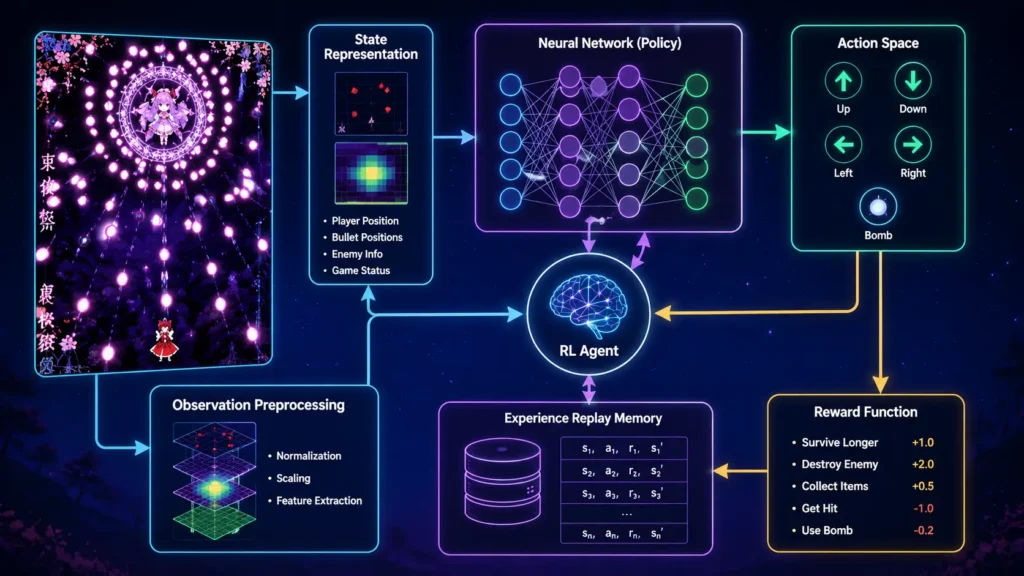
Building an agent capable of playing Touhou usually involves several interconnected pieces working together
- State representation as how the agent “sees” the game, whether through raw pixels, internal coordinates or a hybrid of both
- Action space as the set of moves available, typically directional movement combined with a shoot toggle
- Reward function as a scoring system that penalizes getting hit and rewards survival or point gains
- Neural network architecture as the model that maps states to actions, often built with PyTorch
- Training loop as the repeated cycle of playing, evaluating, and updating the model’s weights
Reinforcement learning is one example of advanced AI software used in modern automation and research.
Pixels vs. Game State
There are two fundamentally different ways to give an AI awareness of what’s happening on screen and each comes with tradeoffs.
| Approach | How It Works | Pros | Cons |
| Pixel based | Agent reads raw screen images | Works on any game without special access | Slower, needs extra processing like segmentation |
| State based | Agent reads internal coordinates directly | Faster, cleaner data | Requires access to game internals, less “realistic” |
Pixel based agents have closer to how a human actually experiences the game since they only see what’s rendered on screen. Some researchers add a semantic segmentation step. Where the model first learns to label each pixel as “bullet” “enemy” “player” or “background” before deciding on a move. This adds a helpful layer of abstraction though it introduces its own speed challenges since segmentation itself takes computing time.
State based agents skip that visual step entirely by feeding the model direct coordinates of the player, enemies and bullets. This tends to train faster and more reliably but it depends on extracting that information from the game’s memory or code, which isn’t always possible or fair to compare against pixel only approaches.
Designing a Function That Actually Works
Getting an agent to survive Touhou’s bullet storms comes down to reward design more than almost anything else. A poorly shaped reward function will teach the agent the wrong lessons entirely.
A practical setup usually includes a penalty for losing health, a small ongoing reward for staying alive, and a bonus tied to points earned from destroying enemies. Balancing these numbers matters: too much emphasis on scoring can make an agent reckless, while too much emphasis on survival can make it overly passive and unwilling to engage enemies at all.
Training Unique to Bullet Hell Games
Training an agent for Touhou surfaces problems that don’t show up in simpler arcade environments like classic Atari titles.
Frame rate pressure is the biggest one. Touhou typically runs at 60 frames per second and any model too slow to keep pace becomes useless regardless of how “smart” it is. Real time semantic segmentation networks built for this kind of task often have to sacrifice some accuracy just to hit that speed target. These systems are also an example of specialized software applications designed for complex decision making.
Sparse, high stakes danger is another challenge. Getting hit by a single bullet among hundreds can end a run instantly which makes the reward signal noisy and unpredictable compared to a game with more gradual failure states.
Longer term planning also comes into play, especially during boss fights that unfold across multiple phases. An agent has to link short term dodging skill with longer strategic patience, which is a much harder combination to learn than reactive dodging alone.
Tips Building Your Own Touhou RL Project
Optimizing performance becomes even more important when running models on embedded software and hardware platforms. Anyone experimenting with playing Touhou with deep reinforcement learning on their own hardware save a lot of frustration by following a few practical habits.
Start with a simplified environment before jumping into a full game clone. Test the reward function on a small toy problem first since bugs in reward logic are far harder to spot once bullets and enemies are added into the mix.
Log everything from the very first training run. Metrics like average survival time and cumulative reward reveal plateaus long before they become obvious in gameplay footage. It’s also worth capping model size early on since oversized networks slow down both training and real-time inference without necessarily improving results.
Finally, expect frequent crashes and dead end experiments. Iteration, not perfection, is what actually produces a working agent.
Where This Field Is Headed

Progress on AI conquering Touhou style bullet hell games has been steady but incremental rather than explosive. Segmentation based pixel models are improving in speed and hybrid approaches that combine vision with some internal state data are gaining traction as a middle ground.
Expect future work to lean more heavily on transfer learning where a model trained on one Touhou title adapts faster to another and cutting down the massive training time these environments usually demand.
Final Thoughts
Getting an AI to survive Lunatic difficulty bullet patterns is still an open problem and that’s part of what makes playing Touhou with deep reinforcement learning such an exciting corner of game AI research. Between reward design, frame rate pressure and the sheer visual chaos on screen, this genre pushes reinforcement learning techniques in ways calmer games never could. Whether you have building a hobby project or contributing to academic research. The lessons learned here carry over to any real time and high stakes AI environment.
FAQs
How to Be Good at Touhou?
Learn your character’s tiny hitbox, practice stages individually and use focused (slow) movement to dodge precisely. Memorize bullet patterns instead of reacting blindly and save bombs for moments you can’t dodge cleanly.
How Do You Unlock the Extra Stage?
Clear all six main stages in one credit, without continuing, on Normal difficulty or higher. Once unlocked it stays available from the stage select menu.
Why Is Touhou So Difficult?
Dense bullet patterns, multi phase boss fights and a strict one hit death rule make it tough. It looks chaotic but is built around learnable and fair patterns.
What Do You Use to Play Touhou?
A Windows PC and a keyboard has arrow keys to move, plus keys for shooting, bombing and focus. Some players use a joystick but it’s less common.