
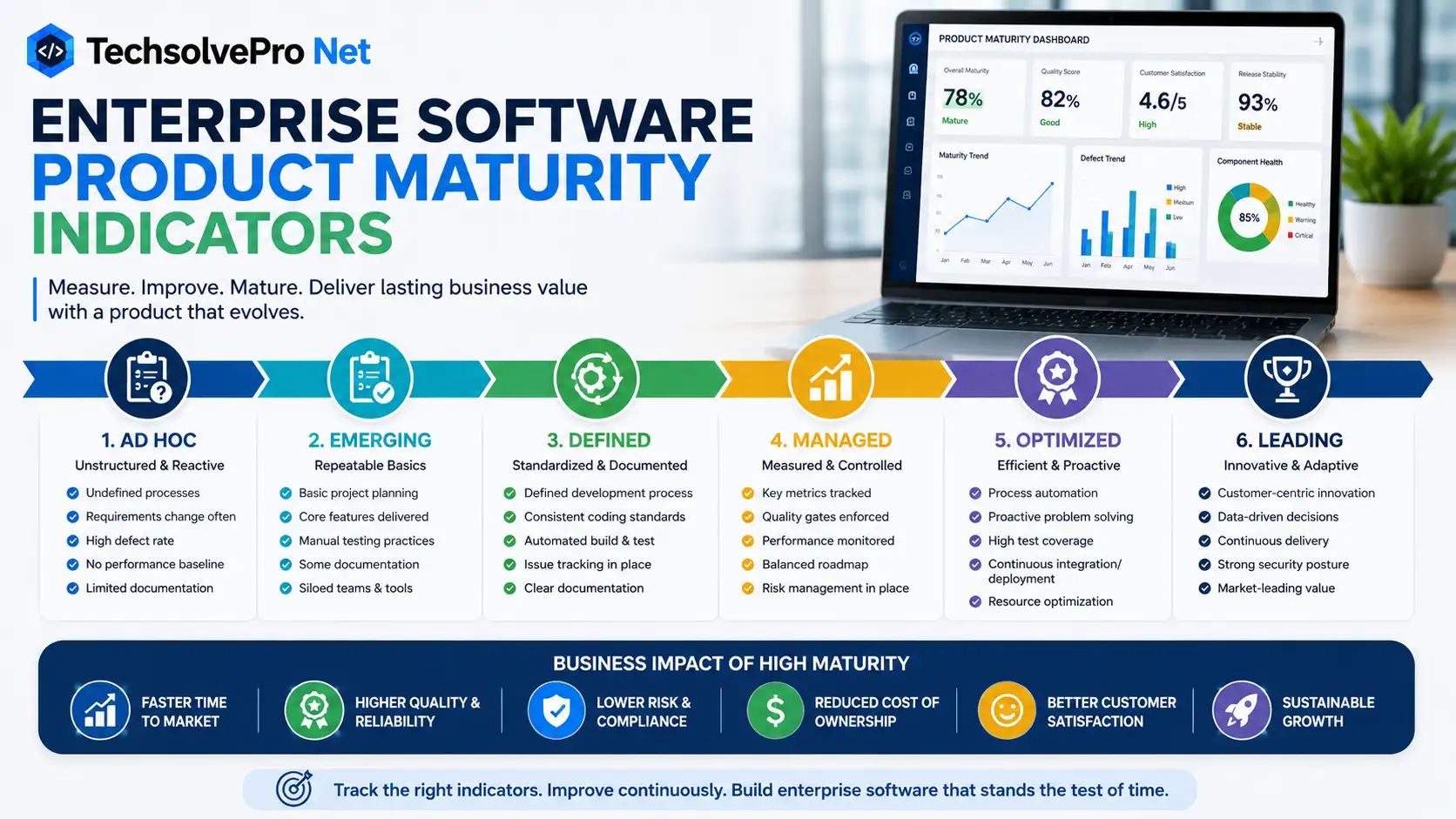
Choosing enterprise software often feel like betting on a product of future not just its present features. A slick demo can hide a codebase that break under real world load and a polished landing page says nothing about how the vendor handles a critical outage at 2 a.m. This has exactly where enterprise software product maturity indicators come in giving buyers and technical teams a way to separate genuinely dependable products from ones still finding their footing.
Most procurement teams focus on price and feature checklists, then get blindsided six months later by scaling issues, missing documentation or a support tech team that can’t keep up. A structured look at maturity indicators catches these problems before a contract gets signed, not after.
What Are Enterprise Software Product Maturity Indicators?
Maturity indicators have measurable signals that show how developed stable and market ready a software product actually is. They cover everything from code quality and release cadence to customer adoption and revenue ecological focus.
Unlike a feature list these indicators answer a deeper question like can this product survive contact with real enterprise workloads, real users and real growth? That distinction matters more than most buyers realize during initial evaluation.
Why Maturity Signals Matter More Than Feature Lists
- Feature parity between competing products is common in mature software categories. What separates a safe choice from a risky one has usually invisible in a sales pitch.
- A product with fewer features but strong maturity signals often outperforms a feature rich but immature alternative over a three year contract. Downtime poor documentation and slow bug fixes cost far more than a missing dashboard widget.
- Enterprises that skip this evaluation step tend to face three recurring problems:
- Vendor lock in with a product that can’t scale past a certain user count
- Support teams that lack the experience to resolve complex, business-critical issues
- Roadmaps that stall because the vendor hasn’t reached financial or operational stability
Core Categories of Enterprise Software Product Maturity Indicators

Maturity hasn’t a single score. It spans four interconnected areas like technical readiness, product quality, market traction and business viability. Strong products show consistent signals across all four not just one.
Technical Readiness Signals
Technical maturity reflects how good the underlying engineering actually is. This includes code ownership and originality, integration compatibility with common enterprise systems and how well the product handles version upgrades without breaking existing workflows.
Third party security audits, uptime history and API stability also fall under this category. A product that change its core APIs every quarter signals an engineering team even experimenting rather than one supporting production systems.
Key Indicators to Evaluate Before Adoption
Buyer seldom are time for a full technical audit before a purchase decision. So it helps to focus on a shorter and high signal checklist:
Release history: Consistent, documented releases over 12 and more months rather than sporadic updates
Customer base depth: Multiple long term enterprise clients across different industries not just a handful of pilot users
Support responsiveness: Published SLAs and evidence the vendor actually meets them
Documentation quality: Accessible technical guide, release documentation and orientation materials
Compliance certifications: Authoritative standard as SOC 2, ISO 27001 or GDPR readiness
Financial stability: Funding Journey and Financial Growth or acquisition risk that could affect long term support
Integration ecosystem: Native connectors or APIs with common enterprise platforms already in use
Comparing Maturity Levels Across a Product’s Lifecycle
Understanding where a product sits on its maturity journey helps set realistic expectations for support and stability.
| Maturity Stage | Typical Traits | Enterprise Risk Level |
| Early/Prototype | Few paying customers, frequent breaking changes | High |
| Growth | Stable APIs, proven uptime, dedicated support teams | Low |
| Established | Expanding customer base, improving documentation | Medium |
| Optimized | Predictable releases, strong compliance, mature partner ecosystem | Lowest |
Products in the growth stage aren’t automatically a bad choice. Many offer better pricing and more responsive product teams. The key is matching the stage to your organization’s risk tolerance.
How to Verify Maturity Claims During Vendor Evaluation
Vendors will naturally present themselves in the best light. So verification matters as much as the pitch itself. Request customer reference from companies similar in size and industry to your own, not carefully selected case studies.
Ask for incident history and how the vendor communicated during past outages. A vendor that shares this openly usually is nothing to hide while one that deflects the question often does.
The Role of Customer Retention in Maturity Assessment
Retention rate tells a story that marketing materials rarely do. A product with high churn even if it has impressive new customer numbers, usually points to unresolved usability or reliability issues.
Ask vendors directly about net revenue retention and average customer tenure. Enterprise software product maturity indicators like these reveal whether existing customers have expanding usage or quietly heading for the exit.
Common Mistakes Buyers Make When Judging Maturity
Many evaluation teams mistake company size for maturity and assuming a well funded startup automatically means a stable product. Funding buys time not necessarily engineering discipline or operational maturity.
Another common error has over relying on analyst reports without checking recent update history. A product praised eighteen months ago may have changed leadership, direction or quality since that review was published.
Practical Tips for Building an Internal Maturity Scorecard

Rather than relying purely on vendor claims and build a simple internal score card weighted toward what matters most for your use in case. Security sensitive industries should weight compliance and audit history heavily. While fast scaling teams might prioritize integration flexibility and support responsiveness instead.
Revisit the scorecard annually, even for products already under contract. Maturity can decline as well as improve especially after acquisitions and leadership changes or major pricing shifts.
Final Thoughts
Evaluating enterprise software product maturity indicators takes more effort than comparing feature lists. But it also helps avoid expensive surprises later. Technical readiness, customer retention, financial stability and support quality together provide a much cleare picture than any single demo or sales presentation. Teams that include this evaluation in their purchasing process. Consistently make safer and more reliable technology decisions that should be the take of time.
FAQs
1. What are the key process and operational indicators?
Mature enterprise software follows clear and consistent development practices. Important indicators include:
Deployment Frequency: How often new updates have released.
Lead Time for Changes: How long it takes place to move a code change into the live product.
Change Failure Rate: The percentage of updates that cause problems or need quick fixes.
2. How is software product maturity measured at the organizational level?
Software maturity also depend on how well a company manages its development process. Many organizations use the Software Capability Maturity Model to measure progress through these stages:
Initial: Work is mostly unplanned and depends on individual team members.
Managed: Basic project management and development tools are in place.
Defined: Teams follow clear and consistent processes across the organization.
Optimizing: The company keeps improving its processes using data and customer feedback.
3. Which metrics indicate value and user-centric maturity?
Building the right product matter as well as the code itself. Leading Key Performance Indicators (KPIs) are
Net Revenue Retention (NRR): how reliable high value clients stay and expand their usage.
Time to Value (TTV): The duration it takes place for an enterprise user to achieve their first gain benefits from the software.
Feature Adoption Rate: The percentage of active users who engage with specific capabilities and showing true product market fit.
Customer Effort Score (CES): Evaluates how smoothly users accomplish their tasks within the enterprise ecosystem.
4. What are the product stability and technical indicators?
Mature software has reliable, secure and easy to maintain. Important indicators join
Defect Density: The amount of bugs found in the software.
System Uptime: Often the software stays online and work without any interruption.
Technical Debt: The numbers of unfinished and outdated code that may be fixed later. Less technical debt usually means make better software quality.